Your Roadmap to Getting a Contractor License in Florida 2026!
Jun 17, 2026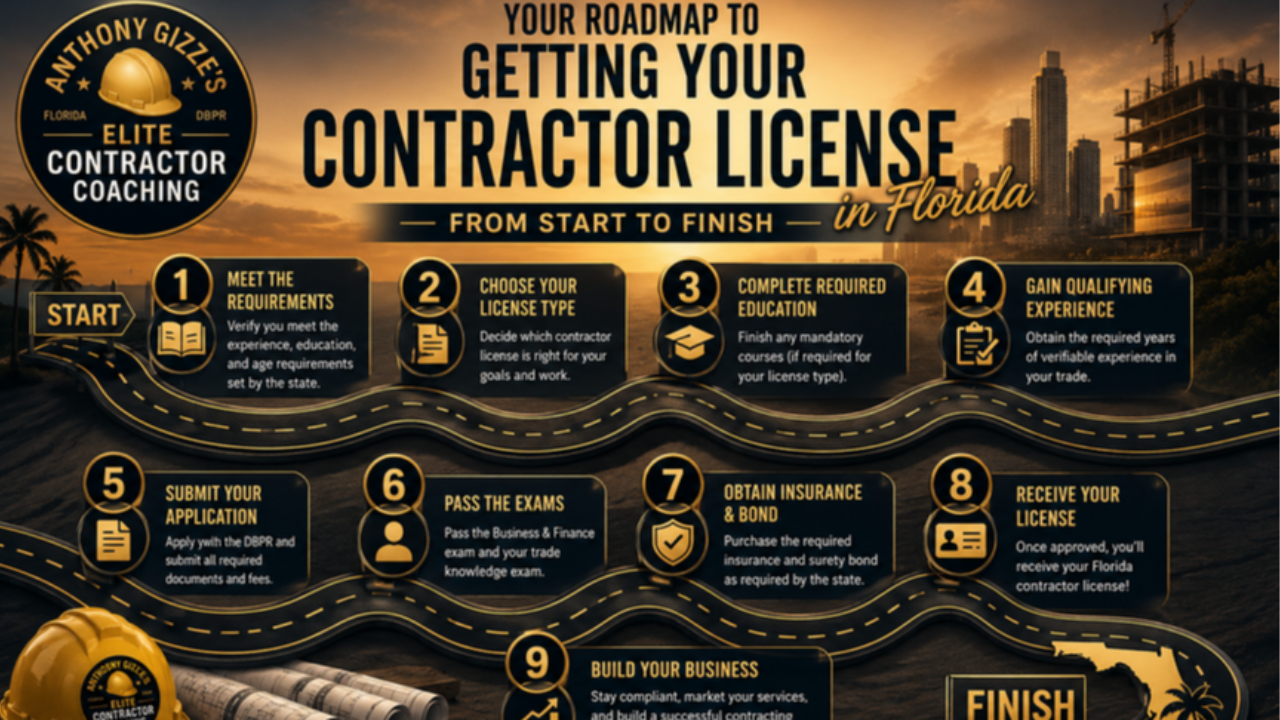
Getting your Florida contractor license can feel overwhelming at first, but the process becomes much easier when you break it down step by step. Whether you want to become a Florida General Contractor, Building Contractor, Roofing Contractor, or another licensed contractor, the goal is the same: prove your experience, pass the required exams, submit a clean application, and show the state you are financially responsible and prepared to operate professionally.
1. Meet the Basic Requirements
The first step is making sure you meet the basic qualifications. Florida contractor applicants generally need to complete the required state examination, show proof of experience for the license category, and meet financial stability and responsibility requirements.
This is where you should review your work history, education, trade experience, and long-term goals. Before spending money on books, courses, or applications, make sure you are pursuing the right license for the type of work you want to perform.
2. Choose the Right License Type
Florida has different contractor license categories, including Certified General Contractor, Certified Building Contractor, Certified Residential Contractor, Roofing Contractor, Plumbing Contractor, and other specialty licenses.
A certified contractor license generally allows you to work statewide in Florida within that license scope. DBPR explains that certified contractors are issued a certificate of competency and may contract in any jurisdiction in the state without having to meet additional local competency requirements.
Choosing the right license matters because it affects what work you can legally perform, what exam you take, and what experience you must prove.
3. Complete Required Education or Experience
Experience is one of the most important parts of the Florida contractor licensing process. For many certified contractor applicants, Florida requires four years of experience or a combination of college education and experience, depending on the license and application type.
This is where many applicants need help. You should organize your work history, supervisors, project types, dates, duties, and proof of hands-on construction experience. The cleaner your documentation is, the stronger your application will be.
4. Gain Qualifying Experience
Florida wants to know that you have real construction knowledge, not just interest in the industry. Your qualifying experience should show that you have worked in the field, managed construction tasks, understood plans, coordinated work, handled jobsite responsibilities, or performed duties related to the license you are applying for.
For example, someone pursuing a Florida General Contractor license should be able to document broader construction experience than someone applying for a narrower specialty license.
5. Submit Your Application
After passing the required state certification examination, applicants seeking a certified contractor license must submit the initial licensure application through DBPR.
Your application may include experience verification, financial responsibility documents, fingerprints, fees, insurance information, and business details if you are qualifying a company. DBPR application fees can vary by application window; one DBPR Certified Contractor Individual application lists initial certification fees of $245 or $145 depending on the filing period.
The key is accuracy. Small mistakes, missing documents, mismatched business names, or incomplete forms can delay approval.
6. Pass the Exams
Most Florida certified contractor applicants must first pass the state certification examination before initial licensure.
The exam process usually includes trade knowledge and business/finance portions, depending on the license type. This is where preparation matters. Get the correct books, study consistently, tab and organize your references where allowed, take practice exams, and create a weekly study schedule.
A contractor license is not something you guess your way through. Treat exam prep like a project with a deadline.
7. Obtain Insurance and Bonding if Required
Before your license is issued, you may need to provide proof of insurance, workers’ compensation coverage or exemption, and meet financial responsibility requirements. Florida requires contractor applicants to demonstrate financial stability and responsibility as part of the licensing process.
Strong credit, clean financial records, and proper business setup can make this step easier. If your goal is to manage clients’ money and large construction projects, financial responsibility is not optional—it is part of becoming a professional.
8. Receive Your License
Once you have passed the exams, submitted a complete application, met experience requirements, completed fingerprints, and satisfied financial and insurance requirements, DBPR can approve and issue your Florida contractor license.
This is a major achievement. It gives you the ability to operate with more credibility, pursue larger projects, and build a legitimate construction business.
9. Build Your Business
Getting licensed is not the finish line—it is the starting line.
After licensure, the next step is learning how to run the business properly. That includes estimating, contracts, permits, inspections, marketing, client communication, accounting, hiring, subcontractor management, and cash flow.
A Florida contractor license can open the door, but business systems help you stay successful once you walk through it.
Final Thoughts
The path to becoming a licensed Florida contractor is very achievable when you follow the right roadmap. Start by choosing the correct license, organize your experience, study for the exams, prepare your application carefully, and build the financial stability needed to operate with confidence.
At Elite Contractor Coaching, we help future contractors understand the process, avoid common mistakes, stay accountable, and move toward becoming licensed professionals.
Your license can change your future—but only if you take the first step.