Florida Certified Plumbing Contractor (CFC) License: The Complete Guide to Building a Successful Plumbing Business
Jun 18, 2026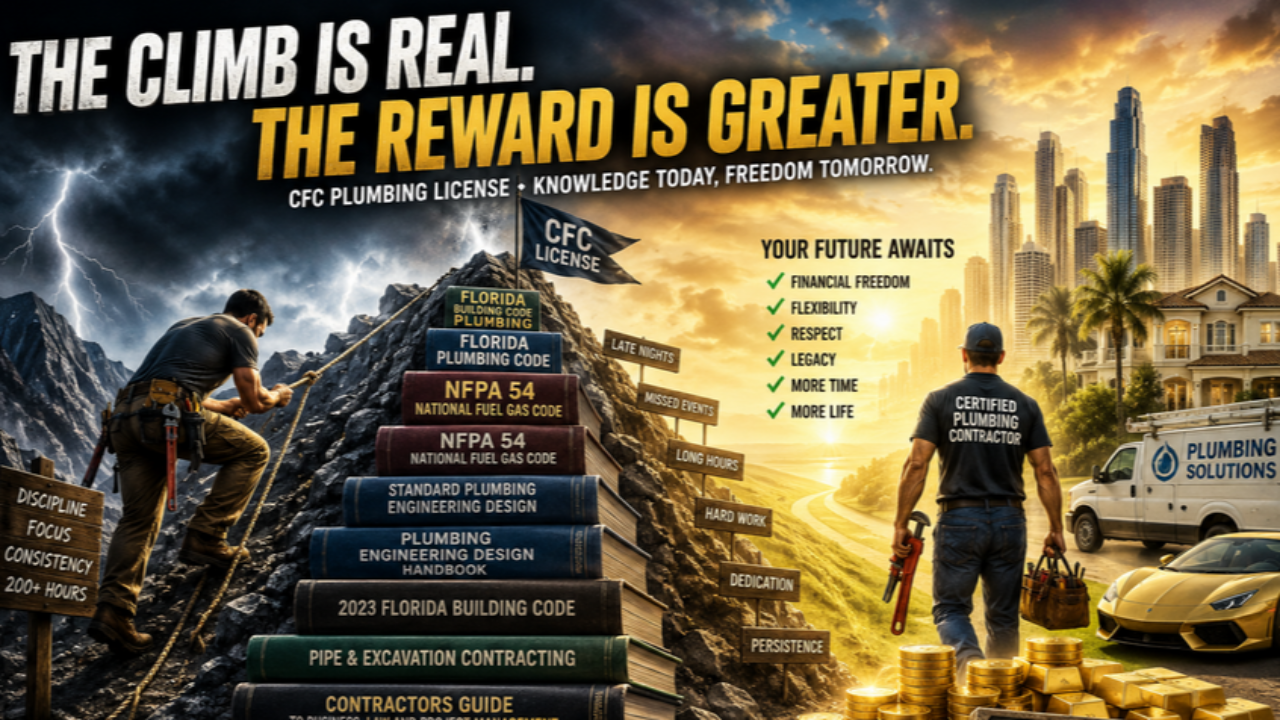
By Elite Contractor Coach (Anthony Gizze)
Why Becoming a Certified Plumbing Contractor Is One of the Best Career Decisions You Can Make
The plumbing industry has always been one of the most respected and essential trades in construction. Every home, office building, restaurant, hospital, school, apartment complex, and industrial facility depends on safe and properly installed plumbing systems. Without licensed plumbing professionals, construction projects simply cannot move forward.
For those who want to own a business rather than work for someone else, earning a Florida Certified Plumbing Contractor (CFC) license is one of the most valuable investments you can make in your future.
Unlike many careers that require years of college debt, the plumbing profession rewards hands-on experience, technical knowledge, discipline, and leadership. A licensed plumbing contractor has the opportunity to build a company, hire employees, manage large commercial projects, and establish a business that can provide financial stability for decades.
The Florida Certified Plumbing Contractor license, issued by the Florida Department of Business and Professional Regulation (DBPR) through the Construction Industry Licensing Board (CILB), allows qualified contractors to perform plumbing work throughout the State of Florida within the scope of the license.
Whether your dream is to own a residential service company, perform commercial plumbing installations, specialize in new construction, or eventually qualify a plumbing company while remaining actively involved in its operations, the CFC license creates opportunities that few careers can match.
What Is a Certified Plumbing Contractor (CFC)?
A Certified Plumbing Contractor is licensed by the State of Florida to install, repair, alter, extend, and maintain plumbing systems in accordance with Florida law and applicable building codes.
Unlike a registered license that is generally limited to a local jurisdiction, a Certified Plumbing Contractor license allows you to perform work statewide within the license scope.
This flexibility is one of the biggest advantages of becoming certified. You are not confined to one county—you can pursue opportunities anywhere in Florida.
Why Plumbing Will Always Be in Demand
Construction trends change.
Technology changes.
Housing markets fluctuate.
But one thing never changes.
People need clean drinking water.
People need functioning sewer systems.
Businesses need plumbing inspections.
Hospitals need sanitary piping systems.
Restaurants require grease waste systems.
Schools require restroom facilities.
Every structure that people occupy depends on plumbing.
That means skilled plumbing contractors remain essential regardless of economic cycles.
Florida's continued population growth creates an ongoing need for licensed contractors capable of performing quality plumbing work safely and in compliance with code.
What Can a Certified Plumbing Contractor Do?
Depending on the authorized scope of work established by Florida law, Certified Plumbing Contractors commonly perform work involving:
- Domestic water distribution systems
- Sanitary drainage systems
- Storm drainage systems
- Vent piping
- Gas piping where authorized
- Water heaters
- Tankless water heaters
- Commercial plumbing
- Residential plumbing
- Medical gas systems (with applicable qualifications where required)
- Fixture installation
- Sewer connections
- Water service lines
- Plumbing remodels
- New construction plumbing
- Commercial tenant improvements
Many contractors eventually specialize in a particular market, while others offer comprehensive plumbing services across residential and commercial construction.
Residential vs. Commercial Plumbing
One of the first decisions you'll eventually make as a plumbing contractor is deciding which market to pursue.
Residential Plumbing
Residential plumbing typically includes:
- Single-family homes
- Duplexes
- Townhomes
- Condominiums
- Apartment maintenance
- Service work
- Remodels
- New home construction
Many contractors begin here because the projects are smaller and allow them to develop strong customer relationships.
Commercial Plumbing
Commercial plumbing introduces larger and more complex systems.
Examples include:
- Restaurants
- Hotels
- Office buildings
- Schools
- Medical facilities
- Warehouses
- Retail stores
- Apartment developments
- Manufacturing facilities
Commercial projects often require more coordination with architects, engineers, inspectors, and other trades, but they also present opportunities to work on larger-scale construction.
Career Opportunities
One of the most exciting aspects of obtaining your CFC license is that it opens multiple career paths.
Some contractors choose to operate a residential service business focused on repairs and maintenance.
Others specialize in:
- New residential construction
- Commercial construction
- High-rise plumbing
- Restaurant build-outs
- Medical facilities
- Municipal infrastructure
- Industrial facilities
- Luxury custom homes
As your company grows, you may transition into estimating, project management, business development, or company leadership while employing licensed plumbers and apprentices.
Income Potential
Your plumbing license is not simply a credential—it is a tool that can help you build a successful business.
Some plumbing contractors prefer to remain small owner-operators, while others grow companies that complete large commercial projects and employ dozens of people.
Your income will depend on factors such as:
- Experience
- Leadership
- Estimating accuracy
- Customer service
- Marketing
- Financial management
- Profit margins
- Business systems
- Team development
The license creates opportunity, but your commitment to learning and operating professionally determines how far that opportunity can take you.
The Road to Becoming a Certified Plumbing Contractor
Success doesn't happen overnight.
Earning a CFC license requires planning, patience, and consistent effort.
Rather than viewing the process as a single examination, think of it as a professional development journey.
You'll need to:
- Build qualifying experience.
- Organize your documentation.
- Learn the reference materials.
- Understand plumbing code.
- Develop business knowledge.
- Prepare for both the Trade Knowledge and Business & Finance examinations.
- Submit a complete application.
- Continue learning even after you become licensed.
Each step prepares you not only to pass an exam but also to operate a responsible construction business.
Build Your Knowledge Before You Build Your Business
One mistake many applicants make is focusing only on passing the test.
Passing the exam is important—but becoming a successful contractor requires much more.
Learn:
- Customer communication
- Estimating
- Contracts
- Scheduling
- Accounting
- Safety
- Leadership
- Project management
- Financial responsibility
The most successful contractors never stop learning.
Every project becomes another opportunity to improve.
Isometric Drawings
One topic that intimidates many future plumbing contractors is the isometric drawing portion of the examination.
Fortunately, it becomes much easier with practice.
What Is an Isometric Drawing?
An isometric drawing is a three-dimensional representation of a plumbing system.
Instead of simply reading plans, you're expected to understand how pipes travel through walls, ceilings, floors, and building spaces.
These drawings help demonstrate:
Pipe elevations
Drainage direction
Vent systems
Offsets
Fixture connections
Proper layout
Many contractors find this section difficult initially because it requires visualizing an entire plumbing system rather than looking at a flat blueprint.
The good news?
Like every other construction skill...
Practice makes it easier.
How to Master Isometric Drawings
Don't try to memorize them.
Understand them.
Use graph paper.
Practice daily.
Draw systems by hand.
Review existing plumbing plans.
Watch instructional videos.
Work through examples.
Ask experienced plumbers to explain real installations.
Over time, your brain begins recognizing patterns.
Eventually you'll begin seeing the plumbing system before you ever pick up your pencil.
Building Your Reference Library
One of the smartest investments you'll make is purchasing the proper reference books.
Many candidates become overwhelmed because they try purchasing everything at once.
Instead...
Build your library one book at a time.
Study each book before purchasing another.
Gradually build your contractor library over several months.
This keeps costs manageable while allowing you to become familiar with each reference.
Organize Your Books Like a Professional
One of the biggest mistakes candidates make is reading books without organizing them.
Remember...
Most contractor examinations are open book.
Knowing where information is located is often just as important as understanding the material itself.
Use:
Sticky tabs
Color coding
Highlighting where permitted
Chapter dividers
Reference indexes
Custom notes
The goal is speed.
Every minute saved looking through your books is another minute available for answering questions.
New Books vs Used Books
Many future contractors ask...
"Should I buy brand-new books?"
Not necessarily.
Many contractors sell complete libraries after passing the examination.
Look for quality used books through:
Facebook Marketplace
Contractor Facebook Groups
Former students
eBay
Local trade organizations
Contractor schools
You may save hundreds—or even thousands—of dollars.
Just be certain you're purchasing the current editions accepted for the examination.
The 200-Hour Study Blueprint
One of the biggest mistakes people make is waiting until the exam is scheduled before they begin studying.
Instead...
Create a plan.
I recommend setting a goal of 200 focused study hours over approximately six months.
Why?
Because consistency beats cramming.
Month One
Goal:
Become familiar with the licensing process.
Purchase your first books.
Organize study space.
Create your calendar.
Study:
8-10 hours weekly.
Hours accumulated:
40
Month Two
Continue purchasing books.
Begin reading daily.
Focus on plumbing code.
Practice locating information.
Review Business & Finance concepts.
Hours accumulated:
80
Month Three
Increase study intensity.
Begin answering practice questions.
Learn plumbing terminology.
Study venting systems.
Begin working isometric exercises.
Hours accumulated:
120
Month Four
Practice open-book navigation.
Time yourself.
Review weak subjects.
Continue drawing plumbing systems.
Increase confidence with code lookups.
Hours accumulated:
160
Month Five
Take practice examinations.
Review incorrect answers.
Refine book organization.
Strengthen Business & Finance knowledge.
Practice isometric drawings every week.
Hours accumulated:
190
Month Six
Complete final reviews.
Focus on confidence rather than cramming.
Review formulas.
Review tabs.
Review frequently missed questions.
Relax.
Trust your preparation.
Final Study Hours:
200+ Hours
Weekly Schedule Example
Monday
2 Hours
Tuesday
2 Hours
Wednesday
2 Hours
Thursday
2 Hours
Friday
1 Hour
Saturday
4 Hours
Sunday
Review mistakes
Total:
Approximately 13-15 hours every week.
That pace allows you to exceed 200 hours comfortably within six months.
Study Like You're Already Running a Company
Treat every study session as an investment.
Turn off your phone.
Close social media.
Sit at a desk.
Take notes.
Review your mistakes.
Stay disciplined.
Professional contractors don't wait until they feel motivated.
They create routines.
Those routines become habits.
Those habits become success.
Accountability Changes Everything
Very few people fail because they lack intelligence.
Most fail because they lose consistency.
- Find accountability.
- Join study groups.
- Attend coaching sessions.
- Track every study hour.
- Celebrate progress.
One hour becomes ten.
Ten becomes fifty.
Fifty becomes one hundred.
Eventually...
Two hundred focused hours transform into something much bigger.
A Florida Certified Plumbing Contractor license.
And that license has the potential to change your career—and your future.