The History of Florida Contractor Licensing: How Hurricane Andrew Changed Construction Forever and Why the International Code Council Shapes the Future of Building
Jun 23, 2026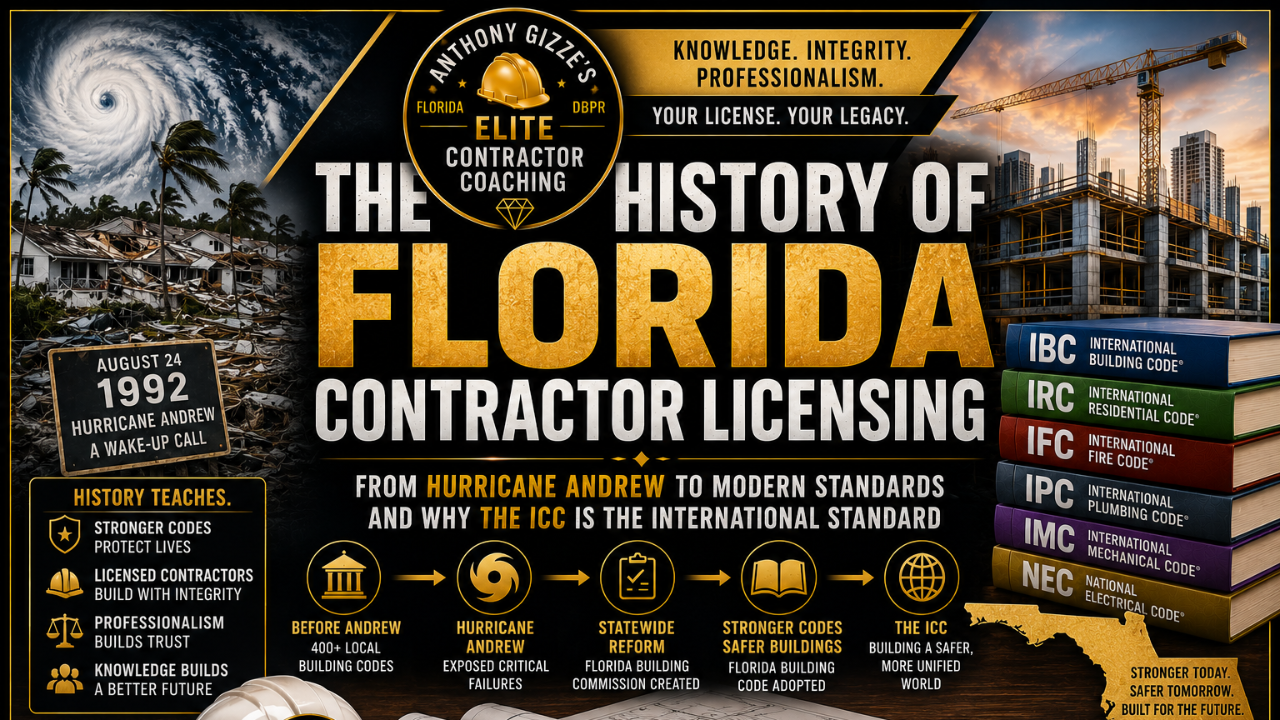
By Elite Contractors Coach (Anthony Gizze)
Understanding the Evolution of Professional Contracting in Florida
Construction has always represented far more than assembling concrete, steel, lumber, and roofing materials into completed buildings. Every structure built throughout history reflects the knowledge, engineering principles, safety standards, and professional judgment of the individuals responsible for its construction. When buildings perform as intended, they often go unnoticed for decades. However, when construction fails, the consequences extend far beyond financial loss. Human lives, families, businesses, and entire communities may be affected.
This reality explains why modern contractor licensing exists.
Many individuals entering the construction industry mistakenly believe contractor licensing serves primarily as an administrative requirement established by state governments to collect fees or regulate businesses. While licensing certainly involves regulatory oversight, its true purpose is considerably more significant. Contractor licensing exists to protect public health, public safety, and public welfare by ensuring that those responsible for constructing, remodeling, repairing, and managing buildings possess the minimum level of knowledge and professional competence necessary to perform that work responsibly.
Few states illustrate the importance of contractor licensing better than Florida.
Because of its unique geography, rapidly expanding population, coastal exposure, hurricane risk, and demanding environmental conditions, Florida has become one of the most highly regulated construction environments anywhere in the United States. The licensing process, the Florida Building Code, continuing education requirements, and rigorous contractor examinations are not accidental. They represent decades of lessons learned through both remarkable growth and devastating natural disasters.
Understanding how Florida arrived at today's licensing system provides valuable perspective for every future contractor. It also explains why the contractor examinations are designed to evaluate not only construction knowledge but also business management, project administration, contract law, ethics, and professional judgment.
Before discussing Hurricane Andrew and the modern Florida Building Code, it is important to understand what construction looked like before these reforms transformed the industry.
Construction in Early Florida
Long before modern building codes existed, construction in Florida varied dramatically from one community to another. During the early and mid-twentieth century, cities and counties often developed their own building regulations independently. Some communities adopted relatively sophisticated construction standards, while others relied upon minimal local requirements or outdated building practices that differed significantly from neighboring jurisdictions.
As Florida's population increased following World War II, rapid development occurred throughout the state. Residential subdivisions expanded into previously undeveloped land, commercial centers emerged throughout growing metropolitan areas, and tourism fueled unprecedented demand for hotels, restaurants, condominiums, and supporting infrastructure.
Unfortunately, the pace of construction frequently exceeded the pace of regulation.
Rather than operating under one uniform statewide building code, Florida contained hundreds of local jurisdictions, each interpreting and enforcing construction standards differently. Contractors working in multiple counties often encountered entirely different permitting procedures, inspection requirements, engineering expectations, and construction practices simply by crossing a county line.
This lack of consistency created unnecessary confusion for contractors, engineers, architects, inspectors, and property owners alike.
It also increased the likelihood that similar buildings would perform differently when subjected to severe weather events.
As Florida continued expanding throughout the 1960s, 1970s, and 1980s, it became increasingly apparent that greater consistency would eventually become necessary.
At the same time, Florida also recognized another important reality.
Construction quality depends heavily upon the qualifications of the people performing the work.
The Purpose of Contractor Licensing
Many people assume contractor licensing exists primarily to make construction more difficult.
Nothing could be further from the truth.
Licensing exists because construction directly affects public safety.
Every structural beam installed incorrectly, every undersized foundation, every improperly wired electrical panel, every incorrectly vented fuel gas appliance, and every improperly engineered roof system has the potential to place occupants at unnecessary risk.
When a homeowner hires a licensed contractor, they are placing tremendous trust in that professional.
They assume the contractor understands structural principles.
They assume the contractor understands applicable building codes.
They assume permits will be obtained.
They assume inspections will be completed.
They assume subcontractors will be managed appropriately.
They assume contracts will be honored ethically.
Most importantly, they assume the completed structure will safely protect their family for decades to come.
Contractor licensing exists to help ensure that this trust is well placed.
Florida's licensing requirements therefore extend well beyond technical construction knowledge.
Modern contractor examinations evaluate applicants in several different professional disciplines, including:
-
Business and Finance
-
Contract Administration
-
Project Management
-
Trade Knowledge
-
Building Codes
-
Safety
-
Legal Responsibilities
-
Workers' Compensation
-
Construction Ethics
These subjects collectively prepare contractors to manage projects responsibly rather than simply perform physical construction work.
In many respects, earning a contractor license represents the transition from skilled trades person to construction professional.
Chapter 489 and Professional Regulation
Today, Florida contractor licensing operates primarily under Chapter 489 of the Florida Statutes, which establishes the legal framework governing construction contracting throughout the state.
Chapter 489 defines contractor classifications, establishes licensing requirements, outlines disciplinary authority, protects consumers, and creates consistent expectations for contractors operating throughout Florida.
Whether an individual seeks to become a Certified General Contractor (CGC), Certified Building Contractor (CBC), Certified Residential Contractor (CRC), Certified Roofing Contractor (CCC), Certified Plumbing Contractor (CFC), or another licensed professional, Chapter 489 establishes the qualifications necessary before that license may be issued.
These qualifications include demonstrated experience, financial responsibility, successful completion of required examinations, background screening, and ongoing continuing education.
Although Chapter 489 has evolved over time through legislative amendments, its central purpose remains unchanged.
Protect the public while promoting professionalism within Florida's construction industry.
As Florida continued growing throughout the late twentieth century, however, another challenge emerged—one that would permanently reshape construction regulation throughout the state.
That challenge arrived on August 24, 1992. Hurricane Andrew.
The Florida Building Code and the Legal Authority Behind It
Understanding How Florida Statutes Support Modern Construction Standards
One of the most important concepts every future Florida contractor must understand is that the Florida Building Code is not simply a technical reference manual. It carries the force of law because it has been adopted through the legislative authority granted by the Florida Legislature. While the code itself provides the technical requirements for designing and constructing buildings, it is the Florida Statutes that give those requirements legal authority and establish the framework for enforcement.
Many students preparing for the Florida contractor examinations mistakenly believe the Building Code and the Florida Statutes are independent documents. In reality, they work together as one comprehensive regulatory system. The statutes establish the legal requirements for construction, licensing, permitting, inspections, and enforcement, while the Florida Building Code provides the technical engineering and construction standards that contractors, architects, engineers, building officials, and inspectors must follow during the construction process.
Understanding this relationship is essential because, throughout your career, you will encounter situations where both the Florida Statutes and the Building Code apply simultaneously.
What Is the Florida Building Code?
The Florida Building Code (FBC) is the statewide set of minimum construction standards adopted to protect the public by establishing uniform requirements for the design, construction, alteration, repair, maintenance, and occupancy of buildings throughout Florida.
Its primary purpose is remarkably simple:
To protect life, health, property, and public safety.
Every requirement found within the code exists because engineers, researchers, code officials, and construction professionals have determined that a particular standard improves the safety, durability, or performance of a building.
Whether the code specifies the required strength of structural connections, the fire-resistance rating of a wall assembly, emergency egress requirements, wind-load calculations, accessibility standards, plumbing installation methods, or electrical safety requirements, each provision has been developed to reduce risk and improve public safety.
The Building Code is therefore much more than a collection of technical rules.
It represents decades of engineering research, construction experience, forensic investigations following structural failures, lessons learned from natural disasters, and continual improvements in building science.
Why Florida Requires a Statewide Building Code
Prior to the adoption of the modern Florida Building Code, local governments throughout Florida enforced hundreds of different building codes. Contractors working across multiple counties frequently encountered different technical standards, different inspection procedures, and different interpretations of construction requirements.
This lack of consistency created confusion for contractors while making statewide construction increasingly difficult to regulate.
Following the devastation caused by Hurricane Andrew in 1992, investigators discovered that inconsistencies in code enforcement and construction practices contributed to unnecessary building failures in some areas. Although many structures performed exactly as intended, others revealed deficiencies involving construction quality, inspection practices, and inconsistent code application.
These findings encouraged Florida to modernize its regulatory system.
Rather than allowing every jurisdiction to maintain significantly different construction standards, Florida established one uniform statewide code applicable throughout the state while still permitting limited local amendments under specific circumstances authorized by law.
The result was the modern Florida Building Code.
Today, whether a contractor performs work in Pensacola, Jacksonville, Orlando, Tampa, Fort Myers, West Palm Beach, Port St. Lucie, or Miami, the same statewide Building Code provides the technical foundation for construction.
Although local administrative procedures may vary, the technical construction requirements remain substantially consistent across Florida.
The Florida Building Commission
The responsibility for developing, maintaining, and updating the Florida Building Code belongs to the Florida Building Commission.
The Commission consists of professionals representing numerous areas of the construction industry, including:
-
Licensed contractors
-
Structural engineers
-
Architects
-
Building officials
-
Fire officials
-
Product manufacturers
-
Local government representatives
-
Code enforcement professionals
-
Consumer representatives
This diverse representation helps ensure that code changes consider engineering principles, construction practicality, public safety, and industry experience simultaneously.
The Commission regularly reviews proposed amendments, evaluates new research, considers technological advances, and adopts updated editions of the Florida Building Code on a recurring cycle.
As construction technology evolves, the code evolves alongside it.
The Relationship Between the Florida Building Code and the International Codes
Many students notice that the Florida Building Code closely resembles publications developed by the International Code Council (ICC).
This is intentional.
The International Code Council develops the family of International Codes (I-Codes) used throughout much of the United States and in many other countries around the world.
These include:
-
International Building Code (IBC)
-
International Residential Code (IRC)
-
International Plumbing Code (IPC)
-
International Mechanical Code (IMC)
-
International Fuel Gas Code (IFGC)
-
International Existing Building Code (IEBC)
-
International Fire Code (IFC)
-
International Energy Conservation Code (IECC)
Rather than creating every technical requirement entirely from scratch, Florida adopts the International Codes as the technical foundation and then modifies them where necessary to address Florida's unique environmental conditions.
These Florida-specific amendments are particularly important because few places in the world experience the combination of challenges found throughout Florida, including:
-
Hurricane-force winds
-
Wind-borne debris
-
Coastal corrosion
-
Flood hazards
-
High groundwater levels
-
High humidity
-
Mold potential
-
Intense ultraviolet exposure
-
Tropical storm activity
Accordingly, Florida's version of the code often contains stricter requirements than those found in many other states.
How Florida Statutes Give the Building Code Legal Authority
One of the most important concepts future contractors must understand is that the Florida Building Code derives its legal authority from the Florida Statutes.
The primary statutory authority is found in Chapter 553, Florida Statutes, commonly known as the Florida Building Codes Act.
Chapter 553 establishes the legal framework for:
-
Adoption of the Florida Building Code
-
Statewide code enforcement
-
Building permits
-
Inspections
-
Product approval
-
Accessibility requirements
-
Energy conservation standards
-
Administration of the Florida Building Commission
Without Chapter 553, the Building Code would simply be a technical publication.
Because the Florida Legislature enacted these statutory provisions, compliance with the Florida Building Code becomes a legal obligation rather than a voluntary recommendation.
For contractors, this distinction is extremely important.
Violating applicable code requirements may result not only in failed inspections but also in contractual disputes, disciplinary action, civil liability, delays, increased costs, and potential enforcement by the appropriate building department.
How Chapter 489 and Chapter 553 Work Together
Although Chapter 553 governs the Building Code itself, contractors must also understand Chapter 489, which regulates contractor licensing.
These chapters complement one another.
Chapter 489 answers questions such as:
-
Who may perform contracting work?
-
What licenses are required?
-
What qualifications must contractors possess?
-
What disciplinary authority exists?
-
What ethical standards apply?
Chapter 553 answers questions such as:
-
How must buildings be constructed?
-
Which code requirements apply?
-
When are permits required?
-
Who performs inspections?
-
How is code compliance achieved?
Together, these chapters create one integrated regulatory system.
One governs the professional.
The other governs the work.
Successful contractors understand both.
Why Contractors Must Know More Than the Minimum Code
One of the greatest mistakes inexperienced contractors make is believing the Building Code represents the highest possible construction standard.
It does not.
The Building Code establishes minimum legal requirements necessary to protect public safety.
Professional contractors often exceed those minimums.
Exceptional craftsmanship, superior materials, improved engineering, enhanced quality control, and careful project management frequently produce buildings that perform well beyond minimum code requirements.
Clients remember contractors who consistently exceed expectations.
The Building Code establishes the floor—not the ceiling—of professional excellence.
Final Thoughts
Understanding the relationship between the Florida Building Code and the Florida Statutes is essential for every future licensed contractor. The statutes establish the legal authority that governs construction, licensing, permitting, inspections, and enforcement, while the Building Code provides the technical standards that transform legislative policy into safe, durable, and resilient buildings.
Together, these laws and codes form the foundation of Florida's modern construction industry.
As you continue preparing for your contractor examinations, remember that every code requirement you study represents far more than a test question. Each provision reflects lessons learned from decades of engineering research, forensic investigations, technological advancement, and real-world construction experience. Your responsibility as a future licensed contractor is not merely to memorize these requirements for an examination, but to understand their purpose and apply them with professionalism throughout your career.
Ultimately, every permit you obtain, every inspection you pass, and every project you complete contributes to a larger mission shared by every licensed contractor in Florida: protecting the safety, property, and trust of the communities you serve.