Can You Get A Florida Contractor License With Bad Credit?
Can You Get A Florida Contractor License With Bad Credit?
Yes, it is possible to get a Florida contractor license even if your credit is not perfect. Bad credit does not automatically end your opportunity to become a licensed contractor in Florida. However, it does mean you need to understand how the DBPR and the Florida Construction Industry Licensing Board review financial responsibility before you submit your application.
This is one of the most important parts of the licensing process, and it is also one of the areas where many applicants become discouraged too early. A low credit score, old collections, past financial mistakes, or a rough season in business does not necessarily mean you cannot move forward. What matters is how your application is prepared, what your current financial picture looks like, and whether you satisfy the state’s financial responsibility requirements.
The DBPR states that certified contractor applicants must pass the Florida contractor exam, meet financial stability and responsibility requirements, and provide proof of experience for the license category they are pursuing.
Why Does Florida Look At Credit For Contractor Licensing?
Florida wants licensed contractors to be financially responsible because contractors often handle large deposits, payroll, materials, subcontractors, permits, inspections, and client funds. When someone hires a contractor, they are trusting that person or company with serious financial responsibility.
That does not mean the state expects every applicant to be wealthy. It means the state wants to see that you are responsible enough to operate in the construction industry and protect the public.
For contractor applicants, financial responsibility is usually reviewed through credit reports for both the individual applicant and the business being qualified. The DBPR financial responsibility guidance explains that applicants must submit a personal credit report and a business credit report, and the reports must show searches at the federal, state, and local levels.
What Credit Score Does DBPR Look For?
The common benchmark is a 660 FICO-derived credit score or higher. If the applicant’s credit score is under 660, the DBPR guidance says the applicant must complete a board-approved 14-hour Financial Responsibility Course.
This is where many people misunderstand the process. A score below 660 does not automatically mean “denied forever.” It usually means you have additional steps to complete before your application is considered financially responsible.
The bigger issue is not just the credit score. Unsatisfied liens, unsatisfied judgments, unresolved financial obligations, or major unexplained issues can create greater problems than a low score by itself.
What If You Have Collections, Charge-Offs, Or Late Payments?
Collections and charge-offs do not always stop you from becoming licensed, but they should not be ignored. Before applying, you should review your credit report carefully and identify anything that may raise questions.
The key items to look for are:
- Unsatisfied judgments
- Unsatisfied liens
- Recent collections
- Tax issues
- Bankruptcy history
- Incorrect information
- Business credit problems
- Accounts showing unpaid balances that are not accurate
If something is incorrect, dispute it before applying. If something is legitimate but unresolved, consider speaking with a qualified professional about the best way to handle it before submitting your DBPR application.
Can You Still Apply With A Credit Score Under 660?
Yes, but you need to be strategic.
If your score is below 660, you should expect to complete the required financial responsibility steps, including the board-approved 14-hour Financial Responsibility Course. The DBPR specifically lists this course as the requirement when the applicant’s credit score is under 660.
The smartest approach is not to panic. The smartest approach is to prepare.
You should know your score, review your reports, clean up what can be cleaned up, complete the required course when necessary, and submit a complete application instead of rushing in with missing information.
The Biggest Mistake Applicants Make
The biggest mistake is applying without reviewing credit first.
Many applicants focus only on passing the contractor exam, but the exam is only one part of the process. You still need experience, fingerprints, insurance after approval, financial responsibility, and a properly prepared application.
A person can study hard, pass the exam, and still create delays because the financial section was not prepared correctly.
That is why I teach students to treat the licensing process like a project. You do not guess. You gather the documents, check the requirements, solve problems early, and move through the process with a plan.
What Should You Do Before Applying?
Before submitting your Florida contractor license application, take these steps:
- Pull your personal credit report.
- Review your business credit report if you already have a company.
- Check for liens, judgments, collections, and public records.
- Confirm whether your score is above or below 660.
- Complete the 14-hour Financial Responsibility Course if required.
- Prepare explanations or supporting documents for any serious credit issues.
- Make sure your business entity is properly organized.
- Do not submit a sloppy or incomplete DBPR application.
This process is not about being perfect. It is about being prepared.
Bad Credit Does Not Mean You Are Not Qualified
A lot of good contractors have gone through financial problems. Some had failed businesses. Some had medical bills. Some went through divorce. Some had slow seasons, bad partnerships, or customers who did not pay. That does not automatically mean they are not capable of being excellent licensed contractors.
The important thing is that you take the licensing process seriously and handle the financial responsibility portion correctly.
Florida does not only want people who know construction. Florida wants contractors who understand business, responsibility, paperwork, compliance, contracts, money management, and consumer protection.
That is why the licensing process includes both trade knowledge and business requirements.
How Elite Contractor Coaching Helps
At Elite Contractor Coaching, we help students understand the complete path to becoming licensed in Florida. That includes the DBPR application, exam preparation, business setup, financial responsibility requirements, and the steps that come after passing the exam.
If your credit is not perfect, do not automatically count yourself out. The right move is to understand where you stand, create a plan, and move forward correctly.
A Florida contractor license can change your entire career. One credit challenge should not stop you from learning the process and taking the next step.
Call To Action
Need help figuring out your path to a Florida contractor license?
Schedule a private Elite Contractor Coaching session and we will go over your license goal, DBPR path, exam requirements, application strategy, and the fastest realistic way to move forward.
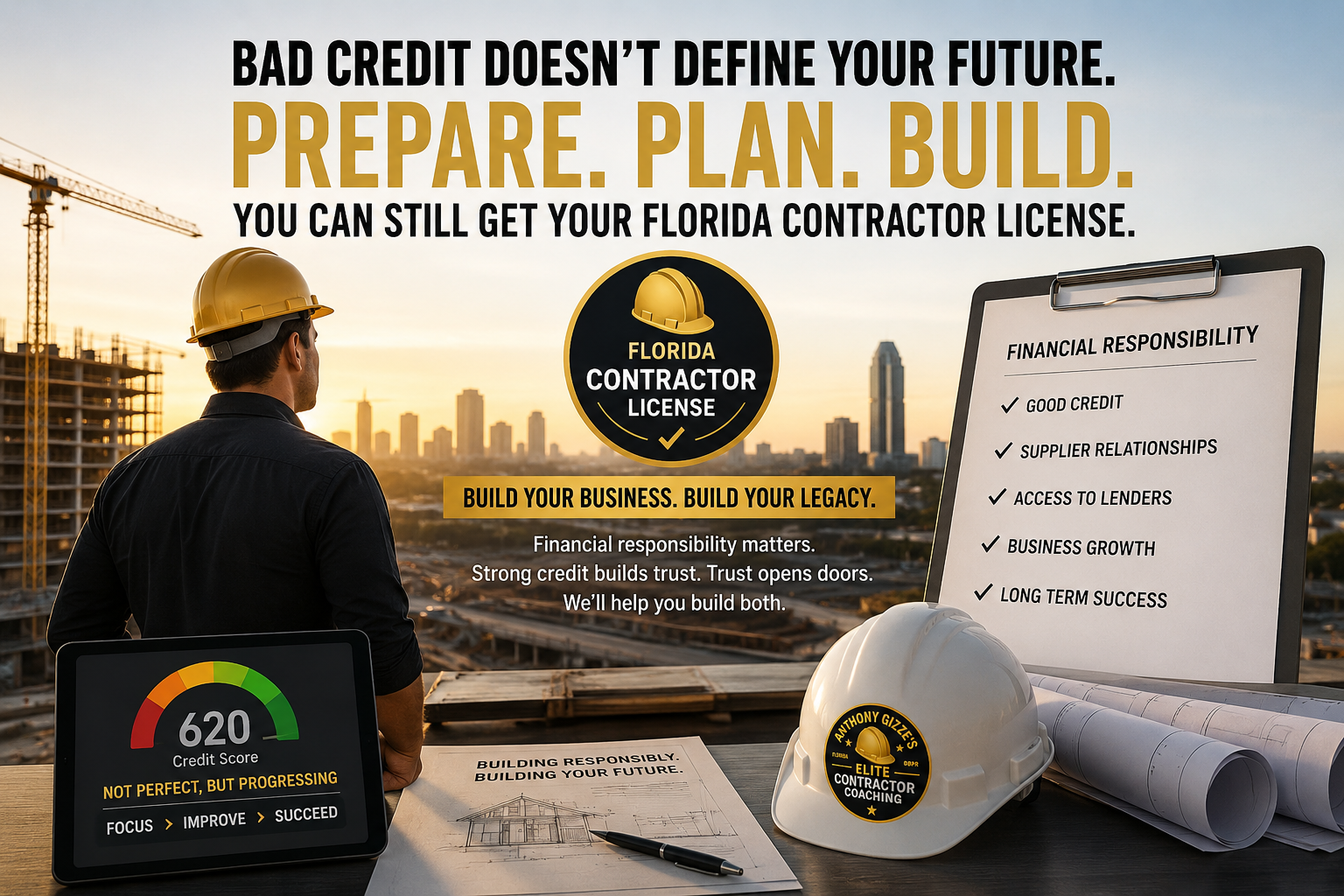
Why Building Your Credit Should Be a Priority While Studying for Your Contractor License
One of the biggest mistakes aspiring contractors make is focusing entirely on passing the exam while ignoring their financial foundation. While obtaining your Florida contractor license is a major milestone, your ability to operate a successful construction business often depends just as much on your financial strength as it does on your construction knowledge.
As you study for your contractor exams, you should also be working to improve your personal and business credit profile.
Strong credit can provide access to supplier accounts, equipment financing, business credit cards, lines of credit, vehicle loans, and banking relationships that become increasingly important as your company grows. In many cases, the contractors who struggle the most after obtaining their license are not the ones who lacked technical knowledge—they are the ones who were financially unprepared for the realities of running a business.
Construction is a cash-intensive industry. Materials often need to be purchased before a client payment is received. Payroll obligations do not wait for invoices to clear. Equipment breaks, unexpected project costs arise, and growth opportunities often require capital. Contractors who have established strong credit and healthy financial relationships are typically better positioned to navigate these challenges without disrupting their operations.
Financial stress is a very real issue in the construction industry. Many talented contractors find themselves overwhelmed not because they lack skill, but because they lack access to working capital when they need it most. The pressure of making payroll, ordering materials, paying insurance premiums, and covering overhead expenses can quickly become overwhelming for an under capitalized business. These situations can lead to poor decisions, project delays, strained client relationships, and unnecessary stress on both the business owner and their family.
For this reason, I encourage every future contractor to view the licensing process as more than simply passing an exam. It is an opportunity to prepare yourself for long-term success.
While you are investing time into studying for the Business and Finance, Project Management, and Contract Administration exams, also invest time into strengthening your credit profile, paying down unnecessary debt, establishing positive payment history, and developing sound financial habits.
Your contractor license opens the door to opportunity. Strong credit helps you walk through that door with confidence. The combination of professional licensing, financial responsibility, and disciplined business practices creates the foundation for a construction company that can survive challenges, capitalize on opportunities, and continue growing for years to come.
At Elite Contractor Coaching, we believe passing the exam is only the beginning. Our goal is to help contractors build not only a license, but a business—and strong financial habits are one of the most important tools you can develop along the way.