How to fill out DBPR Application for Contractors!
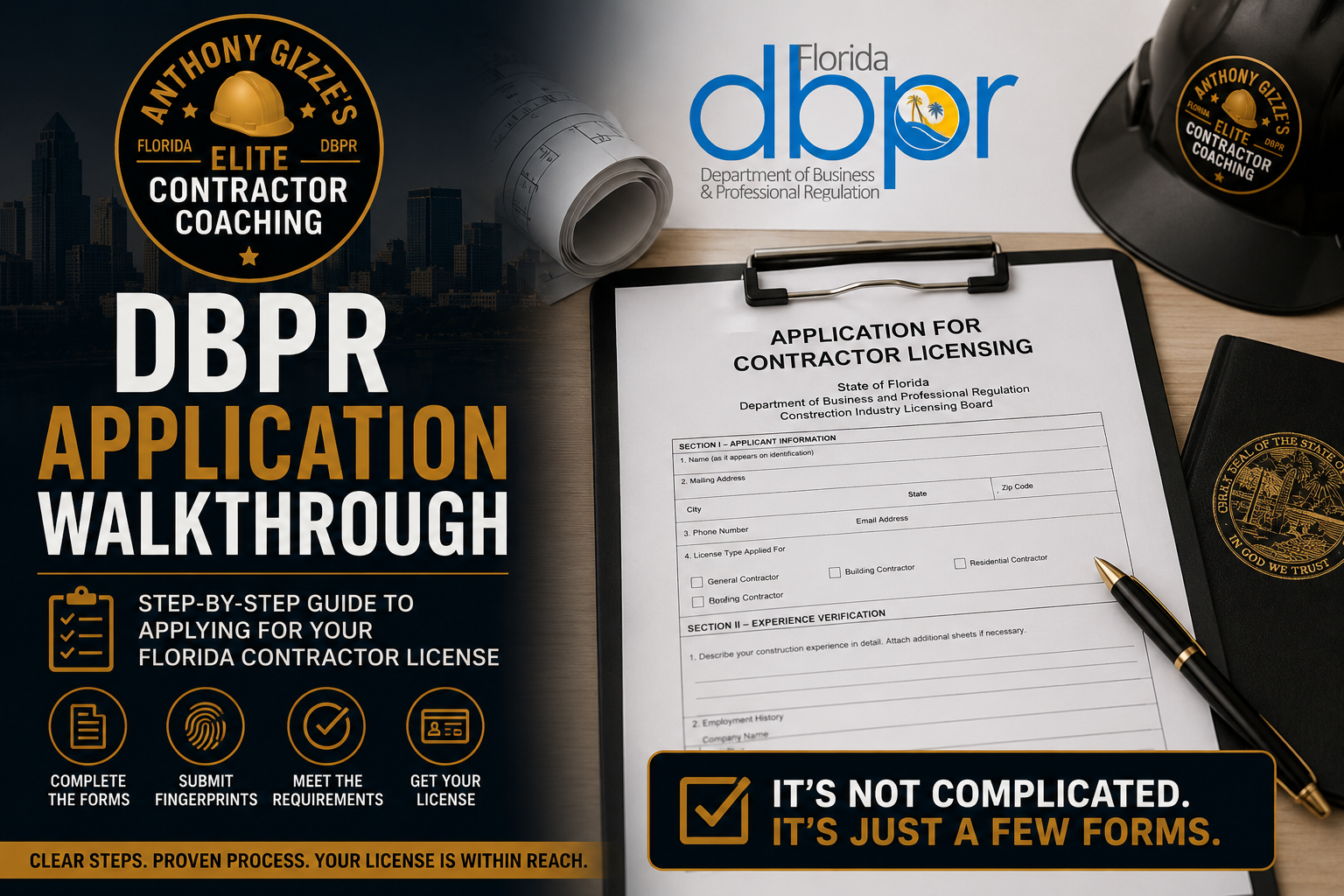
Florida DBPR Contractor License Application Walkthrough
Step-by-Step Guide to Applying for Your Florida Contractor License
Applying for a Florida contractor license can feel overwhelming the first time you look at the application package. Between experience verification, financial responsibility requirements, fingerprinting, examination approvals, and supporting documentation, many applicants become frustrated before they ever submit their paperwork.
The good news is that the process is much simpler when broken down into manageable steps.
At Elite Contractor Coaching, we help future contractors understand exactly what the Florida Department of Business and Professional Regulation (DBPR) is looking for and how to properly complete the application process. This guide provides a high-level overview of the steps involved in becoming a licensed contractor in Florida.
What Is the DBPR?
The Florida Department of Business and Professional Regulation (DBPR) is the state agency responsible for regulating contractor licensing throughout Florida.
The DBPR works alongside the Construction Industry Licensing Board (CILB) to review contractor applications, approve qualified applicants, administer licensing requirements, and enforce contractor regulations under Florida Statute Chapter 489.
If you want to become a:
-
Certified General Contractor (CGC)
-
Certified Building Contractor (CBC)
-
Certified Residential Contractor (CRC)
-
Certified Roofing Contractor (CCC)
-
Certified Plumbing Contractor (CFC)
-
Mechanical Contractor
-
Electrical Contractor
You will be working directly with the DBPR licensing process.
Step 1: Determine Which License You Need
Before beginning your application, determine which license classification best aligns with your experience and career goals.
Common Florida contractor licenses include:
Certified General Contractor (CGC)
May perform residential, commercial, industrial, and large-scale construction projects throughout Florida.
Certified Building Contractor (CBC)
Typically focused on commercial and residential structures up to certain height limitations.
Certified Residential Contractor (CRC)
Focused primarily on residential construction and remodeling.
Specialty Contractor Licenses
Including roofing, plumbing, mechanical, electrical, and other specialty classifications.
Choosing the proper license is one of the most important decisions you will make during the application process.
Step 2: Verify Your Experience
One of the most important portions of the application involves documenting your construction experience.
The DBPR wants to verify that applicants possess the practical knowledge necessary to operate as licensed contractors.
Depending on your background, qualifying experience may include:
-
Construction management
-
Project supervision
-
Field experience
-
Trade experience
-
Business ownership
-
Educational substitutions
Many applicants struggle most with properly documenting and presenting their experience.
Proper experience verification often determines whether an application moves forward smoothly or becomes delayed.
Step 3: Complete the Application Package
Once you determine your license classification and gather your supporting documents, you will complete the appropriate DBPR application.
The application typically requests information regarding:
-
Personal information
-
Employment history
-
Construction experience
-
Business information
-
Financial responsibility
-
Criminal history disclosures
-
Supporting documentation
Accuracy is critical.
Simple errors can delay application processing and create unnecessary complications.
Step 4: Fingerprinting and Background Check
All applicants are required to complete electronic fingerprinting through an approved Livescan provider.
The fingerprint results are submitted directly to the Florida Department of Law Enforcement (FDLE) and the Federal Bureau of Investigation (FBI) for review.
A prior criminal history does not automatically prevent licensure. However, all disclosures should be answered honestly and completely.
Failure to disclose information generally creates more problems than the underlying issue itself.
Step 5: Financial Responsibility Review
Florida requires contractor applicants to demonstrate financial responsibility.
Depending on your circumstances, this may involve:
-
Personal credit review
-
Credit reports
-
Financial statements
-
Additional documentation if required
Financial responsibility is an important component of contractor licensing because licensed contractors routinely enter into contracts involving substantial financial obligations.
Step 6: Receive Examination Approval
After the DBPR reviews and approves your application, eligible applicants are authorized to register for the required examinations.
Most contractor license classifications require passing examinations administered through Pearson VUE.
The examination process may include:
-
Business and Finance
-
Contract Administration
-
Project Management
-
Trade-Specific Examination Content
This is where proper preparation becomes extremely important.
Step 7: Pass the Contractor Examinations
Many applicants spend hundreds of hours preparing for the Florida contractor examinations.
Success typically comes from:
-
Understanding the reference books
-
Learning navigation techniques
-
Developing efficient study habits
-
Taking practice exams
-
Following a structured study plan
Passing the examination is a major milestone on your path toward becoming a licensed contractor.
Step 8: Final License Issuance
After successfully satisfying all requirements, the DBPR may issue your Florida contractor license.
Once licensed, contractors can begin:
-
Pulling permits
-
Registering with local building departments
-
Opening construction companies
-
Obtaining insurance
-
Marketing services
-
Building their businesses
This is where your career as a licensed Florida contractor officially begins.
Common Application Mistakes
Many delays occur because applicants:
-
Submit incomplete experience verification
-
Forget supporting documentation
-
Misunderstand financial requirements
-
Select the wrong application
-
Leave questions unanswered
-
Fail to disclose required information
A properly prepared application can significantly reduce delays and improve the overall experience.
How Elite Contractor Coaching Helps
The DBPR application process can be intimidating when you attempt to navigate it alone.
Our coaching programs help students understand:
-
Which application to use
-
How to document experience
-
What supporting documents are required
-
Financial responsibility requirements
-
Examination preparation
-
Contractor licensing strategies
-
Business startup planning
Our goal is to simplify the process so you can focus on achieving your contractor license and building your future.
Ready to Begin?
Obtaining a Florida contractor license is one of the most valuable investments you can make in your construction career.
If you're unsure where to start, schedule an Elite Strategy Session and receive personalized guidance designed around your specific goals, experience, and licensing objectives.
The application process may seem complex today, but with the right roadmap, it becomes a step-by-step journey toward a lifetime of opportunity.
Don't Overthink the Application Process
One of the biggest mistakes future contractors make is convincing themselves that the DBPR application is more complicated than it really is.
Every year, countless qualified individuals delay their contractor license because they spend months worrying about the paperwork instead of simply getting started.
The truth is that the application is primarily a collection of forms designed to verify who you are, what experience you have, and whether you meet the state's licensing requirements.
At its core, you're simply providing:
- Your personal information
- Your construction experience
- Fingerprints and background check
- Financial responsibility documentation
- Supporting records when required
That's it.
Many applicants build the process up in their minds and imagine hundreds of pages of legal paperwork. In reality, most of the application consists of straightforward questions and supporting documentation that can be gathered one step at a time.
The key is not trying to complete everything at once.
Focus on one section at a time.
Complete your experience verification.
Gather your supporting documents.
Submit your fingerprints.
Prepare for your exams.
Before you know it, you'll have a complete application package ready for submission.
Remember, thousands of contractors before you have successfully completed this exact process. The contractors who become licensed are not necessarily the smartest or most experienced—they're the ones who take action instead of allowing uncertainty to stop them.
Don't let a few forms stand between you and a career that could change your life.
Start the process, stay organized, and keep moving forward. One completed section at a time eventually becomes a completed application, and a completed application is the first step toward becoming a licensed Florida contractor.